
Students and staff came together for a three-day residential Jamboree at Cumberland Lodge in Windsor from Sunday 12 April to Wednesday 15 April 2026. The event combined collaborative hackathon work, student presentations, expert seminar talks and valuable opportunities to build connections beyond the usual campus setting.
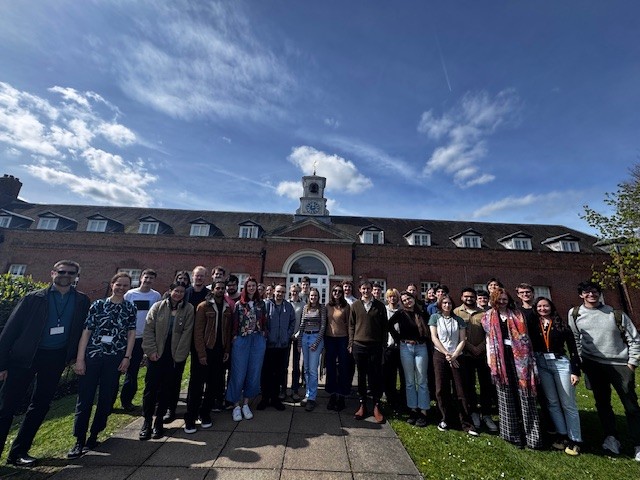
The Jamboree began on Sunday with arrivals, a welcome talk and a shared dinner. The programme then moved into a full schedule of academic and collaborative activities, giving participants the opportunity to develop ideas, share knowledge and work together in an informal and supportive environment.
On Monday, participants took part in an introduction to the hackathon and group allocations, followed by practical sessions on mixed R/Python visualisation led by Nicola Rennie. Students then worked in groups throughout the afternoon on their hackathon projects. The day also included a talk by Alberto Garabato from the University of Southampton, providing an opportunity to engage with research beyond the immediate project work.
Tuesday focused on developing the hackathon projects further. Groups continued their work throughout the day and began preparing their presentations. The programme also featured short three-minute presentations by first-year students, followed by further group work to finalise the presentations.
The final day featured group presentations, with six teams presenting their work followed by discussion. A prize ceremony recognised the achievements of participants before the programme continued with a series of symposium talks. Speakers included:
- Sarah Dance from the University of Reading, who spoke about using observations to improve numerical weather prediction.
- Etienne Roesch from the University of Reading, who explored reproducibility and responsibility in scientific research.
- Nicole Shibley from the University of Cambridge, who discussed ice in a mostly Arctic context.
- Coralia Cartis from the University of Oxford, who spoke about optimisation algorithms for problems in climate.
Alongside the academic programme, the residential also had an important social dimension. In the evenings, students and staff came together to relax, socialise and play games. These informal activities helped participants get to know one another, strengthened the sense of community and complemented the focused daytime sessions.
Feedback from students was highly positive. Participants valued the opportunity to work collaboratively, learn from staff and peers, and spend time together in a relaxed residential setting. Many students said that they would like to see more events of this kind in the future.
The Jamboree was a productive and enjoyable event, bringing together collaborative learning, research discussions and community-building activities. It created new connections across students and staff and provided a strong foundation for future events.